

Few weapons in history feel as alien and as gripping as the macuahuitl. It looks, at first glance, like a flat wooden paddle. Then you notice the gleaming black blades set along its edges, and the whole impression changes in an instant.
This is the weapon that startled Spanish conquistadors, that lives on in codices and museum catalogs, and that now travels far beyond Mexico. The story of the macuahuitl worldwide is really a story about how a single, strange, brilliant object refused to be forgotten.
Today the obsidian Aztec sword turns up in university lectures, in collector workshops, in video games, and on YouTube channels run by curious blacksmiths. Yet most people have never seen a real one, because almost none survive. That tension—huge fame, almost no originals—is exactly what makes this subject so fascinating.
In this guide we will trace the weapon from the battlefields of Tenochtitlan to glass display cases on three continents. Along the way you will meet the chroniclers who described it, the fire that destroyed the last known example, and the modern fans keeping its memory alive.
What Is the Real Macuahuitl Aztec Sword?
Let us start with the basics, because the name alone causes confusion. Macuahuitl comes from Nahuatl, the language of the Mexica people, and is often translated loosely as "hand-wood" or, more colorfully, "hungry wood." It was not a sword in the European sense at all.
The real macuahuitl Aztec sword was a length of hardwood, usually oak, carved into a paddle or club shape. Along both edges, craftsmen embedded rows of razor-sharp prismatic blades made from obsidian, a naturally occurring volcanic glass. The result sat somewhere between a sword, a saw, and a club.
That hybrid design is the heart of its genius. A European blade cuts with a single continuous edge of steel. The Aztec weapon, by contrast, combined the heavy momentum of a club with a serrated line of glass that could open flesh with frightening ease. It was a slashing weapon first, a crushing weapon second.
Warriors of every rank carried versions of it. Elite jaguar and eagle warriors wielded large two-handed models, while lighter one-handed types were common among rank-and-file fighters. If you want to understand the wider arsenal it belonged to, our overview of Aztec weapons and warfare sets the full picture.
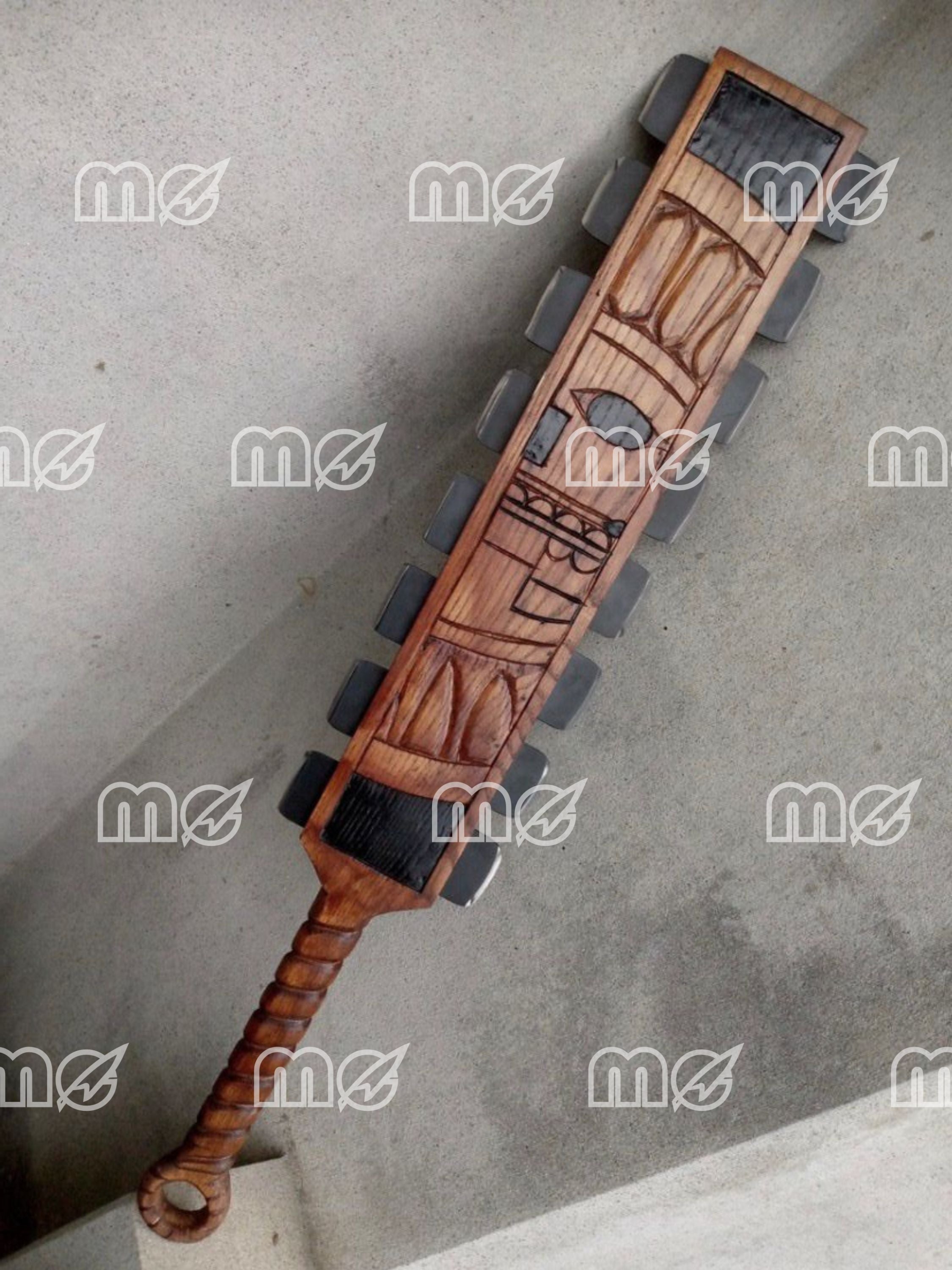
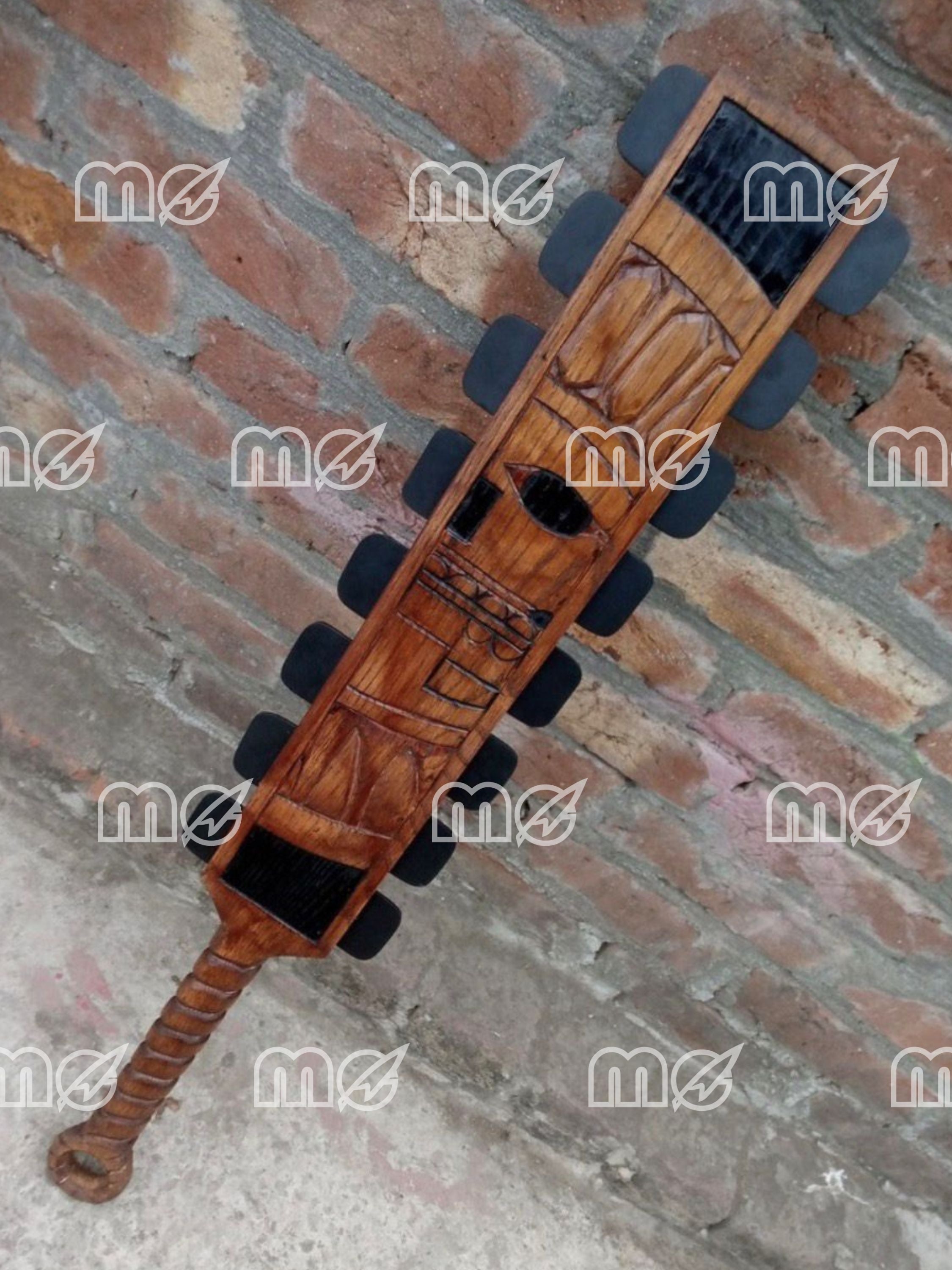
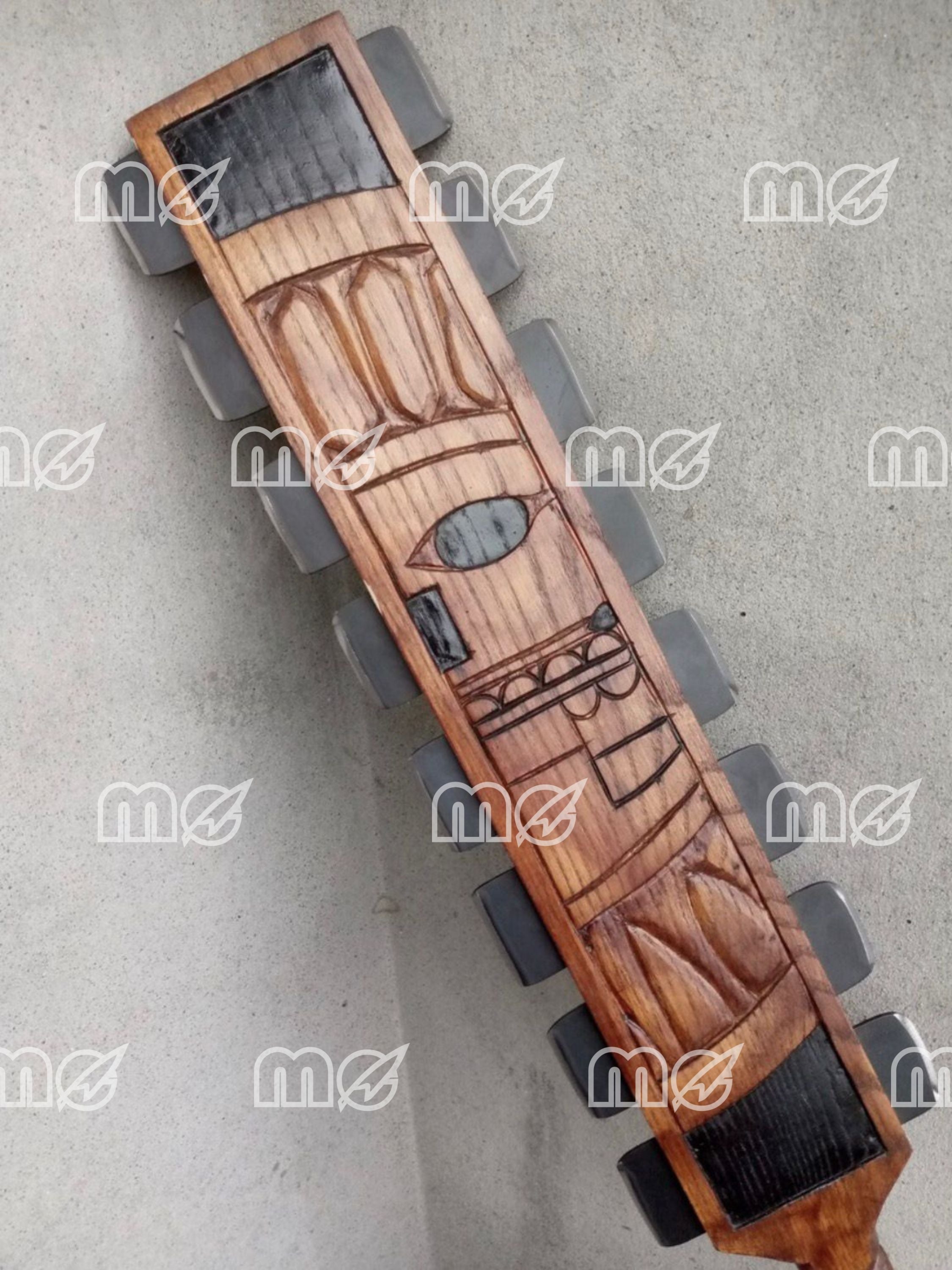
Best Aztec Obsidian Sword
Handmade Engraved Aztec Sword
Bring home a striking piece of Aztec-inspired artistry with this handmade decorative sword, crafted for collectors who appreciate real craftsmanship. Each blade is hand-forged from high-quality carbon steel and polished to a bold, eye-catching finish, while the solid ash wood handle wrapped in genuine brown leather offers an authentic, historic feel. Antique-finished brass accents add a refined, elegant touch that lets this piece stand out on any wall, shelf, or themed display. Individually made by skilled artisans, no two swords are exactly alike—so you receive a one-of-a-kind collectible with its own character. Whether it's for your own collection or a memorable gift for him on a birthday, Christmas, or Father's Day, this elegant handcrafted sword adds personality, heritage, and a touch of history to any space.
Pros
Cons
How the Obsidian Blades Were Made
Obsidian is the secret ingredient that turns a wooden club into something legendary. Found in abundance around central Mexico, this volcanic glass can be worked into edges of almost unbelievable sharpness. According to studies cited by the Smithsonian and other institutions, a freshly knapped obsidian edge can be many times sharper than surgical steel.
Aztec artisans quarried obsidian from sources such as the Sierra de las Navajas, fittingly nicknamed the "Razor Mountains." There, as detailed in research summarized by Ancient Origins, skilled knappers struck long, thin prismatic blades from a prepared core in a process that left almost no waste.
These blades were then fitted into grooves carved along the wooden shaft and glued in place with a natural adhesive, often a resin or bitumen mix. The fit was so tight, Spanish observers reported, that the blades could not easily be pulled out by hand. That craftsmanship is a major reason the obsidian Aztec sword earned such respect.
There was, however, a trade-off. Obsidian is astonishingly sharp but also brittle. A blade could shatter against bone, shield, or steel armor, which is why warriors needed the modular design—broken segments could be replaced rather than scrapping the whole weapon.
Myth, Reality, and the Horse-Decapitating Legend
No discussion of this weapon escapes the famous claim that it could behead a horse in a single blow. The story comes straight from the conquistadors themselves. Soldier-chronicler Bernal Díaz del Castillo, who fought alongside Hernán Cortés, described a strike that cut a mare's neck so deeply her head hung by the skin, as recorded in his account of the conquest now widely available through Project Gutenberg.
Other Spaniards, including the writer known only as the Anonymous Conqueror, told similar tales of horses and even men being grievously cut. To Europeans raised on Toledo steel, the idea that glass-edged wood could match their finest blades was genuinely shocking.
Modern experimental archaeology paints a more measured picture. Reconstructions tested by researchers and by television programs such as *Deadliest Warrior* show that the weapon could inflict deep, ugly wounds and fracture bone, but cleanly decapitating a living horse in one stroke is highly improbable. The truth sits between legend and skepticism: a fearsome cutter, just not a magic one.
This nuance matters for trust. A reliable account of the real macuahuitl Aztec sword should celebrate its genuine effectiveness while gently retiring the tallest tales. The weapon was deadly enough without exaggeration.
The Last Real Macuahuitl and the Fire That Erased It
Here is the detail that gives the whole subject its melancholy edge. After the Spanish conquest, at least one authentic macuahuitl made its way to Europe and ended up in the Royal Armoury of Madrid, the Real Armería, alongside another Mesoamerican weapon called the tepoztopilli.
For centuries it survived as a tangible link to the Mexica world. Then disaster struck. On the night of 9–10 July 1884, a fire tore through the armoury. As multiple historians—including the anthropologist Ross Hassig—have documented, the last known original was destroyed, a loss noted in the record of the Royal Armoury of Madrid.
That single fire is why no verified original exists in any collection on Earth today. Everything we see in museums now is either a reconstruction or an interpretation based on surviving evidence. It is a sobering thought: one of history's most famous weapons is known almost entirely through copies and descriptions.
What we do still have is a 19th-century drawing of the Madrid specimen, produced for the armoury catalog by the medievalist Achille Jubinal. That illustration, combined with indigenous codices, gives scholars their best window onto the weapon's true proportions. Without it, the spread of the macuahuitl worldwide would rest on far shakier ground.
So when you read claims about an "authentic" example for sale, healthy skepticism is wise. The honest answer is that genuine pre-conquest specimens are, for now, lost to history. Anyone studying the obsidian Aztec sword has to work from drawings, texts, and a handful of obsidian fragments excavated archaeologically.
The Macuahuitl Worldwide: Museum Collections and Replicas
If no original survives, how did this weapon become a global icon? The answer lies in faithful reconstructions, in surviving documents, and in the willingness of museums everywhere to tell the Aztec story. The journey of the macuahuitl worldwide is, in large part, a story of careful recreation.
Across Mexico, institutions such as the Museo Nacional de Antropología in Mexico City present detailed replicas alongside obsidian tools, codices, and warrior regalia. These displays let visitors grasp the scale and craft of the weapon even though the wood-and-glass originals long ago decayed or burned.
Beyond Mexico, the influence spreads wide. European and North American museums that cover the Spanish conquest frequently feature reconstructions to illustrate what Cortés and his men actually faced. The weapon has become shorthand for Mesoamerican ingenuity, a single object that communicates an entire military culture at a glance.
This is why the phrase aztec sword global feels so apt. The artifact may be rooted in one valley in central Mexico, yet its image now circulates through institutions, books, and exhibitions on nearly every continent. Few weapons from any ancient civilization enjoy that reach.
Codices and Catalogs That Keep the Memory Alive
Museums could not display anything convincing without primary sources, and here the indigenous and colonial record is unusually rich. Painted manuscripts such as the Codex Mendoza, the Florentine Codex, and the Codex Telleriano-Remensis all depict warriors holding the weapon in vivid color.
These codices do more than confirm the weapon existed. They show how it was held, which warrior ranks carried which sizes, and how it fit into ceremonies and tribute records. For anyone researching the obsidian Aztec sword, these painted books are the closest thing to a photograph from the period.
The Florentine Codex, compiled by the Franciscan friar Bernardino de Sahagún with Nahua collaborators, is especially valuable because it pairs imagery with Nahuatl text. You can explore digitized pages through the World Digital Library and related archives, which has helped scholars worldwide study the weapon without traveling to a single archive.
Together with Jubinal's catalog drawing of the lost Madrid piece, these documents form the evidence base that makes responsible reconstruction possible. They are the reason a modern replica can claim real accuracy rather than guesswork.
Reconstructions in Museums and Cultural Centers
The modern reconstruction movement deserves real credit for the weapon's fame. Talented makers, some affiliated with museums and others working independently, have built faithful versions using period-appropriate oak, obsidian, and natural adhesives. One widely shared ceremonial recreation by the craftsman Shai Azoulai has appeared in countless articles about the topic.
These reconstructions serve two purposes at once. They give the public something striking to look at, and they give researchers a testable object. When a maker follows the codices and the Madrid drawing closely, the resulting weapon becomes a kind of experiment in itself, revealing how the original might have balanced, swung, and cut.
Cultural centers across Mexico and among the Mexican diaspora also use these pieces in educational programs and reenactments. The weapon becomes a teaching tool, a way to connect younger generations with Mexica heritage that colonial history tried hard to erase.
If you are interested in how ancient craft techniques are revived today, our feature on obsidian knapping and ancient tools digs into the methods involved. It pairs naturally with the broader spread of the macuahuitl worldwide, because every accurate replica depends on rediscovered skills.
Collector Communities and the Modern Obsidian Aztec Sword Revival
Beyond formal institutions sits a passionate world of private collectors, hobbyist bladesmiths, and historical martial artists. This community has quietly become one of the strongest engines behind the weapon's lasting fame, keeping interest in the obsidian Aztec sword alive year after year.
Online forums and marketplaces are full of handmade reproductions ranging from rough decorative pieces to museum-grade recreations costing serious money. Skilled artisans take commissions, sourcing real obsidian and hardwood to build weapons that look and feel close to the originals described in the codices.
It is worth a clear word of caution here. Because no authenticated pre-conquest example survives, any item advertised as a genuine ancient macuahuitl should be treated with deep suspicion. Reputable sellers are upfront that their work is a reconstruction, and ethical collectors prize craftsmanship and accuracy rather than false claims of antiquity.
For many enthusiasts, the appeal is precisely that they are building, not buying, history. Forging a faithful obsidian Aztec sword from scratch connects a maker directly to the knappers of five centuries ago. That hands-on link is something a mass-produced steel replica can never match.
The collector scene also overlaps with the world of experimental reenactment. Practitioners study the codices to recreate not just the weapon but the stances and strikes that might have accompanied it, turning a static object into living, moving history. In this way the community does serious cultural work while having a great deal of fun.
Academic Interest and Experimental Archaeology
The scholarly fascination runs just as deep. Historians, anthropologists, and materials scientists have all found rich questions in this weapon, and their work explains a great deal about why the macuahuitl worldwide has earned such credibility rather than being dismissed as a curiosity.
Anthropologist Ross Hassig, whose work on Aztec warfare is widely cited, placed the weapon within the broader logic of Mexica combat. The Aztecs often fought not to kill outright but to capture enemies for ritual purposes, and a weapon that disabled and wounded suited that aim. Understanding that goal reframes the whole design.
Materials scientists, meanwhile, are drawn to obsidian itself. Because a fresh obsidian edge can be sharper than steel at the microscopic level, the glass has even been studied for use in modern surgical scalpels. That genuine scientific interest lends the obsidian Aztec sword a credibility that pure folklore never could.
Experimental archaeology ties these threads together. By building accurate reconstructions and testing them against ballistic gel, animal carcasses, and replica armor, researchers move beyond debating old chronicles and gather real data. The findings generally confirm a brutally effective cutter that nonetheless had clear limits against steel and bone.
This rigorous, evidence-led approach is exactly what good scholarship looks like. It honors the conquistador accounts without swallowing every claim whole, and it treats indigenous sources as the authoritative record they are. For readers who want trustworthy information, the academic conversation is the gold standard. You can explore related Mesoamerican research through our history of Mesoamerican civilizations guide.
Aztec Sword Global Pop Culture: Games, Screens, and Imagination
Here is where the weapon truly conquered the planet. Long after the Mexica empire fell, the macuahuitl found a vast new audience through entertainment, and the "aztec sword global" footprint owes much to screens and controllers.
Video games have been especially influential. Strategy classics such as the Age of Empires series and the Civilization franchise feature Aztec factions whose warriors swing obsidian-edged weapons, introducing the design to millions of players who might never crack open a history book. Action and fantasy titles have followed, often using the weapon to signal a fierce, exotic combatant.
Television and documentary programming amplified the reach further. The reconstruction-and-testing format of shows like Deadliest Warrior put the weapon in front of mainstream audiences, dramatizing its cutting power and seeding the very horse-decapitation legend that scholars now carefully qualify.
The internet did the rest. Bladesmithing channels, history explainers, and short-form video creators regularly feature the weapon, and each viral clip pulls a fresh wave of curious viewers toward the real history behind it. In this sense, the macuahuitl worldwide is partly a creation of the digital age.
What is striking is how often pop culture acts as a gateway rather than an endpoint. Someone meets the weapon in a game, gets curious, and ends up reading about Tenochtitlan, the codices, and the Madrid fire. The entertainment hook leads to genuine learning, which is the best outcome any historical artifact could hope for. If you enjoy that crossover, our piece on [ancient weapons in modern media](/ancient-weapons-in-modern-media) explores the pattern across cultures.
Why the Macuahuitl Still Captures the Imagination
Step back and the appeal becomes clear. The weapon sits at a perfect intersection of beauty, brutality, ingenuity, and loss. It is gorgeous to look at, terrifying in function, clever in design, and tragically almost extinct as an authentic object.
That last point gives it a haunting quality. We know it through words, paintings, and a single old drawing, which means every encounter with the obsidian Aztec sword is also an encounter with absence. We are always looking at a reconstruction of something the world allowed to slip away.
It also embodies a culture too often flattened into clichés. The macuahuitl reminds us that the Mexica were sophisticated metallurgists of glass, brilliant craftsmen, and strategic thinkers, not the simplistic figures of old colonial narratives. Honoring the weapon means honoring that complexity.
And it travels well precisely because it explains so much so quickly. Hand someone a faithful replica and they instantly grasp a whole world of warfare, ritual, and resourcefulness. No wonder museums, scholars, collectors, and game designers alike keep reaching for it.
Conclusion
The journey of the macuahuitl worldwide is one of history's more poignant success stories. A wood-and-obsidian weapon, with no surviving original anywhere on Earth, has nonetheless become a global icon recognized from Mexico City to museum halls and gaming screens across the planet.
We have traced how the real macuahuitl Aztec sword was built, how the last known specimen burned in Madrid in 1884, and how codices and careful reconstruction kept its memory alive. We have seen collectors revive the craft, scholars test the legends, and pop culture carry the design to millions.
The lesson is encouraging. Even an object the world nearly lost can be recovered, studied, and honored through evidence and curiosity. The obsidian Aztec sword endures not because originals survive, but because so many people across so many fields refuse to let it fade.
If this overview sparked your interest, the natural next step is to look closer at the culture that created it. Exploring Mexica history, art, and warfare turns a striking weapon into a doorway, and that doorway opens onto one of the most remarkable civilizations the Americas ever produced.
Frequently Asked Questions
Does a real macuahuitl Aztec sword still exist anywhere?
No authenticated pre-conquest example is known to survive today. The last verified original was kept in the Royal Armoury of Madrid and was destroyed in a fire in 1884. Everything currently in museums and private collections is a reconstruction based on codices, Spanish chronicles, and a 19th-century catalog drawing of the lost Madrid piece.
Was the obsidian Aztec sword really sharper than steel?
In a microscopic sense, yes. A freshly knapped obsidian edge can be sharper than surgical steel, which is why obsidian has even been studied for scalpel blades. The trade-off is brittleness: obsidian cuts beautifully through soft tissue but can chip or shatter against bone, armor, or another hard surface, so the blades were designed to be replaceable.
Could a macuahuitl actually decapitate a horse?
Spanish chroniclers like Bernal Díaz del Castillo claimed it could nearly behead a horse in one blow. Modern experimental archaeology shows the weapon could inflict deep wounds and fracture bone, but cleanly decapitating a living horse in a single stroke is highly improbable. The weapon was genuinely fearsome, even if the tallest tales are exaggerated.
Why is the macuahuitl so famous worldwide if no originals exist?
Its fame as the macuahuitl worldwide rests on three pillars: rich primary sources such as the Codex Mendoza and Florentine Codex, the dramatic conquistador accounts, and modern reconstruction by skilled makers. Video games, documentaries, and online creators then carried the design to a global audience, turning a regional weapon into an international icon.
Where can I see a macuahuitl today?
Your best option is a museum that covers Aztec or Mesoamerican history, such as the Museo Nacional de Antropología in Mexico City, where detailed reconstructions are displayed alongside obsidian tools and warrior regalia. Many institutions covering the Spanish conquest also feature replicas, and high-quality reconstructions are available from reputable specialist craftspeople.
